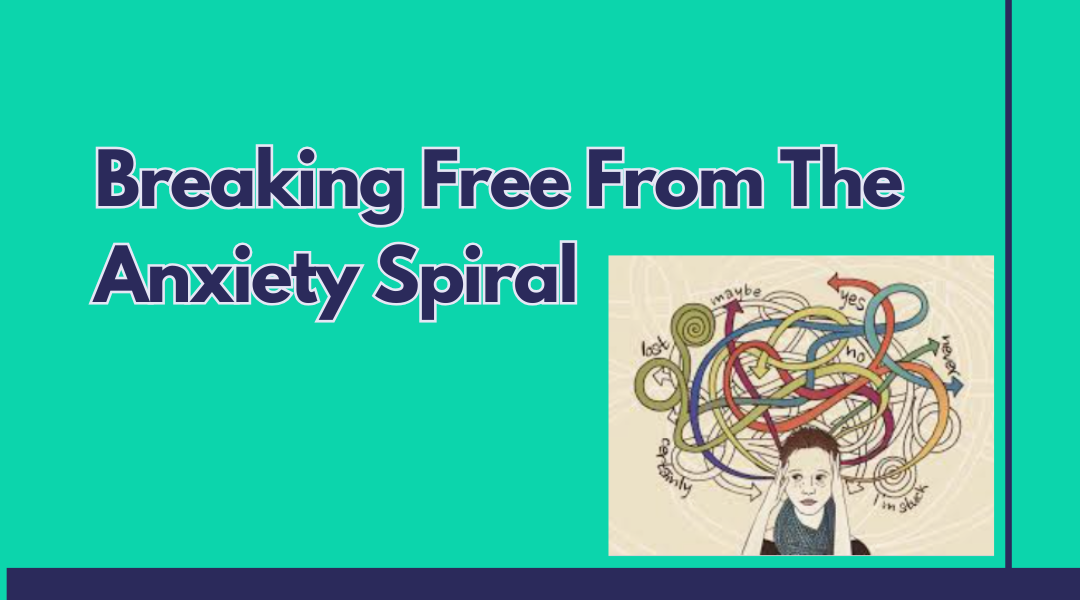
We’ve all been there – it’s 2 AM, the house is quiet, but your mind won’t shut off. What started as a passing thought about tomorrow’s meeting suddenly snowballs into catastrophic scenarios about your career, health, and relationships. Your heartbeat quickens, your palms get clammy, and suddenly you’re wide awake staring at the ceiling.
This isn’t just overthinking – it’s your brain stuck in an anxiety loop. Like a record skipping on the same troubling track, your thoughts keep circling back to worries that feel impossible to escape.
Why Our Brains Get Stuck
Neuroscientists have found that anxiety actually changes how our brains process information. When we’re stressed, the amygdala (our brain’s alarm system) goes into overdrive, while the prefrontal cortex (our rational thinking center) takes a backseat.
It explains why:
- A slight chest tightness becomes “I’m having a heart attack”
- A friend’s delayed text turns into “They hate me”
- A minor work mistake spirals into “I’ll get fired”
The good news? We can retrain this response.
Practical Ways to Hit Pause
1. The 5-4-3-2-1 Grounding Technique
When Sarah, a teacher from Chicago, felt panic rising during parent-teacher conferences, she’d discreetly:
- Spot 5 yellow items in the room
- Feel 4 textures (her pen, chair fabric, etc.)
- Identify 3 background sounds
- Notice 2 smells (coffee, whiteboard markers)
- Name 1 positive thing about the moment
“It gave my racing thoughts something concrete to latch onto,” she says. “Within minutes, I could feel my breathing normalize.”
2. Mental Math Challenges
Mark, an accountant, keeps anxiety at bay during his commute by:
- Calculating gas mileage in his head
- Adding up license plate numbers
- Estimating grocery totals before checkout
“Numbers are my comfort zone,” he admits. “When I focus on calculations, there’s no room for irrational fears.”
3. Memory Immersion
Close your eyes and vividly recall:
- The smell of your grandmother’s kitchen
- The sound of ocean waves from your last vacation
- The texture of your favorite childhood blanket
A 2023 University of Michigan study found this technique reduces cortisol levels by up to 28% in anxious participants.
4. Purposeful Movement
When anxiety strikes:
- Organize a junk drawer
- Do a crossword puzzle
- Sort your bookshelf by color
- Practice a few yoga stretches
Physical therapist Dr. Elena Rodriguez explains: “The combination of mild physical activity and focused attention creates new neural pathways that bypass anxious thought patterns.”
Real Breakthroughs
James, a veteran, used to wake in panic from nightmares. Now he keeps a “focus kit” by his bed:
- A Rubik’s cube
- A scented candle
- A list of movie quotes to memorize
“It’s not about avoiding the feelings,” he says. “It’s about giving my brain healthier ways to process them.”
The Bigger Picture
Anxiety specialist Dr. Naomi Chen emphasizes: “These techniques aren’t quick fixes – they’re mental muscle training. With consistent practice, you’re literally rewiring your brain’s response to stress.”
Remember:
- It’s normal – your brain is trying to protect you
- You’re not broken – you’re learning new skills
- Small steps create real change
Next time you feel the spiral starting, try one of these approaches. You might be surprised how quickly you can shift gears. After all, you’re the conductor of your thoughts – not a passenger on a runaway train.