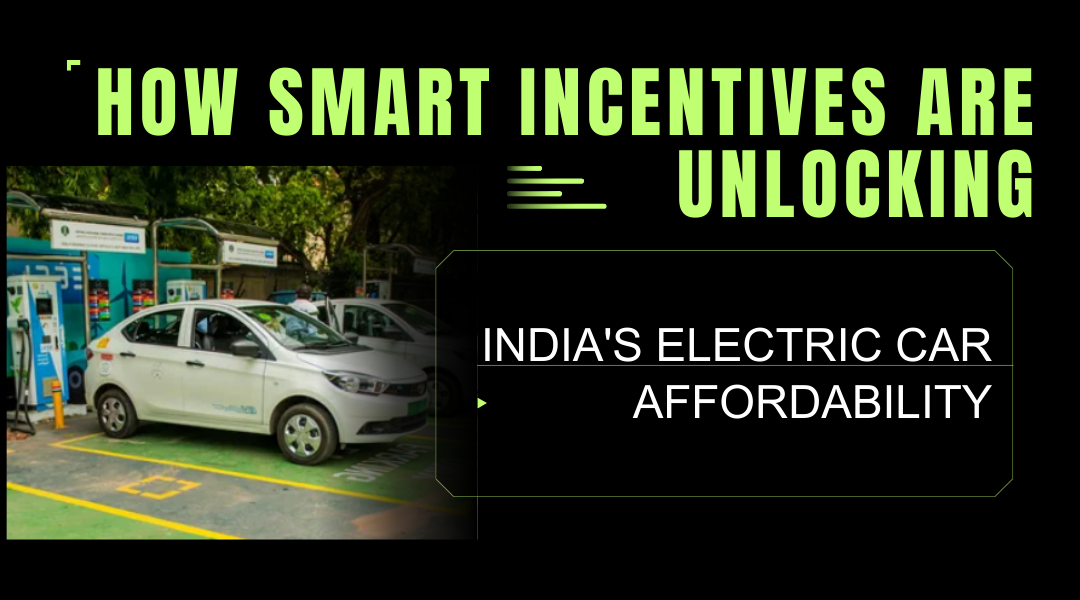
For countless Indian families, the dream of owning a new car is a meticulously planned financial milestone. It involves years of saving, comparing brochures, and visiting showrooms. For years, this dream was powered almost exclusively by petrol or diesel. Then, electric vehicles (EVs) entered the scene, promising a quieter, cleaner, and cheaper-to-run future. Yet, for many, they remained a tantalizing but distant prospect, locked behind a significant price barrier. The question wasn’t about desire, but pure economics: “How can I justify paying significantly more for a car today to save money tomorrow?”
The answer has emerged not from car company boardrooms alone, but from a powerful, multi-layered strategy of financial incentives. This isn’t just about slapping a discount on a price tag. It’s a sophisticated, national effort to rewire the entire cost calculus of car ownership, making the electric choice not just an aspirational one, but an irrefutably intelligent financial decision for the mainstream buyer.
The Great Price Hurdle: Understanding the Initial Sticker Shock
To appreciate the power of incentives, one must first understand the nature of the barrier they are designed to overcome. The primary reason for the high upfront cost of an electric car is the battery pack. This complex assembly of lithium-ion cells is the technological heart of the EV, but it’s also its most expensive single component. Even with prices falling globally, it still adds a substantial premium over the engine and transmission of a conventional car.
This creates a cognitive dissonance for the buyer. They see a petrol car priced at ₹10 lakh and a comparable EV at ₹15 lakh. The running cost savings, while substantial, feel abstract and long-term. The extra ₹5 lakh, however, is a concrete, immediate financial hurdle. Incentives are the strategic lever designed to bridge this very gap, transforming the purchase from a leap of faith into a step of logic.
The Incentive Toolkit: A Multi-Pronged Assault on Cost
The government and financial institutions have not relied on a single tool. Instead, they have launched a coordinated assault on the cost of EV ownership from multiple angles, creating a cumulative effect that is far greater than the sum of its parts.
1. The Direct Price Cut: The FAME-II Subsidy
The most visible and impactful incentive has been the Faster Adoption and Manufacturing of Electric Vehicles (FAME-II) scheme. Think of this not as a simple subsidy, but as a direct financial bridge across the price chasm.
Here’s how it works in practice: A manufacturer sets an ex-factory price for an eligible EV. Under FAME-II, a predetermined incentive (typically calculated per kWh of battery capacity) is passed directly to the customer, effectively reducing the invoice price. This isn’t a tax rebate you claim later; it’s an instant discount at the point of purchase.
- The Psychological Impact: This immediate price reduction is powerful. It shifts the EV from one price bracket to a lower, more familiar one. A car that was once in the “premium” segment suddenly becomes a viable contender in the “mass-market” segment, fundamentally altering the consumer’s consideration set.
2. The Tax Advantage: Leaving More Money in Your Pocket
Parallel to direct subsidies, the tax system has been leveraged to make EVs fiscally attractive.
- Reduced GST: The Goods and Services Tax (GST) on electric vehicles was slashed to 5%, one of the lowest rates for any automobile. In contrast, petrol and diesel cars attract a hefty 28% GST, plus additional cess. This policy is a clear signal of national priority, deliberately making the cleaner technology the more fiscally privileged one.
- Income Tax Benefits: Under Section 80EEB of the Income Tax Act, buyers can claim a deduction of up to ₹1.5 lakh on the interest paid on a loan taken to purchase an electric vehicle. For an individual in the 30% tax slab, this can translate into a direct tax saving of up to ₹45,000 over the loan’s duration. This cleverly targets the salaried, loan-taking demographic, which forms a huge chunk of new car buyers.
3. The State-Level Push: A Federal Race to the Top
The incentive story isn’t confined to the national capital. State governments, recognizing the economic and environmental benefits, have entered the fray with their own policies. Many states offer:
- Complete Exemption on Road Tax and Registration Fees: These are significant one-time costs that can add ₹50,000 to ₹2 lakhs (or more) to the on-road price of a car. Waiving these fees provides another substantial upfront saving, making the final payment delivered to the showroom dramatically lower.
- Additional Cash Incentives: Some states offer direct subsidies over and above the FAME-II benefit, further sweetening the deal.
This federal competition creates a patchwork of highly favorable environments, ensuring that potential buyers in virtually every region of the country have access to a compelling financial package.
4. The Lower Cost of Capital: Making the Loan Cheaper
For the 75-80% of Indians who finance their car purchase, the Equated Monthly Instalment (EMI) is the ultimate decider. Financial institutions have joined the party by offering electric vehicle loans at significantly lower interest rates compared to loans for internal combustion engine (ICE) vehicles.
A difference of even 1-2% in interest rate can save the buyer tens of thousands of rupees over the loan tenure. This reduces the monthly outflow, making the EV fit more comfortably into the household budget. When combined with the tax deduction on loan interest, the cost of financing an EV becomes exceptionally attractive.
Connecting the Dots: A Real-World Affordability Calculation
Let’s move from theory to a tangible, illustrative example. Imagine a popular electric car with an ex-showroom price of ₹15,00,000.
- Step 1: FAME-II Subsidy: A direct benefit of, say, ₹1,50,000 is applied. New effective cost: ₹13,50,000.
- Step 2: State Benefits: The state government waives road tax and registration fees, which might have been ₹1,20,000. The on-road price is now ₹13,50,000 (a saving of over ₹2.7 lakh from the sticker price).
- Step 3: The Loan Advantage: The buyer takes a loan for this amount at a preferential 7% interest rate, instead of the standard 9% for a petrol car. Over a 5-year period, this 2% difference saves a significant amount in interest.
- Step 4: Tax Savings: The interest paid on the loan qualifies for a deduction, saving the buyer up to ₹45,000 in taxes.
Suddenly, the effective financial outlay for the ₹15 lakh EV begins to feel much closer to that of a ₹12-13 lakh petrol car. The incentives have successfully bridged the initial price gap.
The Long-Term Amplifier: Incentives and the Total Cost of Ownership (TCO)
The true genius of this incentive structure is how it amplifies the already favorable Total Cost of Ownership (TCO) of an electric car.
Incentives dramatically lower the acquisition cost, which is the first and biggest component of TCO. By doing so, they drastically shorten the “payback period”—the time it takes for the fuel and maintenance savings to cover the EV’s price premium. Without incentives, this period might be 7-8 years. With incentives, it can shrink to an incredibly compelling 3-4 years. For a commercial fleet operator, this makes the decision a no-brainer.
The Ripple Effect: How Incentives Benefit the Entire Ecosystem
The impact of these financial incentives extends far beyond the individual buyer:
- Boosting Manufacturing Scale: Higher sales volumes, fueled by incentives, allow manufacturers to invest in local production and achieve economies of scale. This, in turn, helps drive down the inherent cost of the vehicles, creating a virtuous cycle.
- Developing the Supply Chain: A growing market attracts investment in the entire supply chain, from battery components to charging infrastructure, creating jobs and fostering technological innovation.
- Normalizing EV Technology: As more EVs hit the road, they cease to be exotic novelties and become mainstream products, building consumer confidence and accelerating adoption organically.
Conclusion: From Artificial Nudge to Organic Choice
The sophisticated framework of EV incentives in India is far more than a temporary discount program. It is a carefully engineered catalyst, designed to overcome the initial inertia of a new technology and trigger a self-sustaining market transformation. These financial levers—subsidies, tax breaks, and low-interest loans—work in concert to rewire the consumer’s economic logic, making the sustainable choice the smartest financial choice.
The ultimate goal of these incentives is to make themselves obsolete. By creating a vibrant, competitive, and scaled-up EV market, they are driving down costs and building consumer confidence to a point where the electric vehicle will stand on its own merits, without needing a financial crutch. We are witnessing a transition, masterfully guided by policy, from an era where electric cars were an expensive alternative to one where they are the default, affordable, and obvious choice for the Indian car buyer. The code to affordability has been cracked, and it’s opening the garage doors for a generation.